Managing more vacation rentals should create room for growth. But each new property also brings another calendar, turnover, set of guest questions, owner expectations, and possibility of a missed handoff.
The short answer: To manage more vacation rentals without losing control, standardize the work that repeats across properties, keep reservation and guest information easy for your team to find, assign an owner to every time-sensitive task, and review exceptions every day. Then automate predictable messages and reminders while keeping people responsible for decisions that need judgment.
Here is a practical way to build that system.
1. Map the work around each stay
Start with the guest journey, from booking to the final follow-up. For each stage, write down what needs to happen, when it needs to happen, and who is responsible.
| Stage | Examples of work to track | What can go wrong |
| Booking | Confirm reservation details; check rates and restrictions | A change does not reach the right channel or teammate |
| Pre-arrival | Collect required information; share check-in instructions; confirm property readiness | The guest arrives without access details |
| Arrival | Monitor access issues and urgent messages | A time-sensitive request sits in the wrong inbox |
| During the stay | Answer questions; coordinate maintenance; document issues | Two people respond differently or nobody takes ownership |
| Departure | Send check-out details; schedule and verify the turnover | The next arrival is too close to an unfinished clean |
| Post-stay | Resolve open issues; review feedback; update the owner | A recurring problem is handled once but never fixed |
This map becomes your operating checklist. It should be specific enough for a new teammate to use, but short enough to follow on a busy turnover day.
2. Give every property a reliable source of information
Guest instructions, access details, house rules, Wi-Fi information, vendor contacts, and property-specific exceptions should have a clear home. If someone has to search old messages or ask the person who “usually knows”, the process becomes harder to scale.
For each property, maintain a current record of:
- Arrival and departure instructions
- Amenities and common guest questions
- Cleaning and inspection requirements
- Maintenance contacts and escalation steps
- Owner preferences and approval rules
- Any instructions that differ from your usual process
Assign someone to update that record when a lock code, vendor, amenity, or rule changes. An outdated guide can create more work than having no guide at all.
3. Make turnovers visible from start to finish
A scheduled clean is not the same as a guest-ready property. On a tight changeover, your team needs to know whether the cleaner accepted the job, completed it, flagged a problem, and confirmed the property is ready.
Build a turnover workflow with a named owner, due time, completion status, and a way to report exceptions. Include the items that regularly cause last-minute issues: linens, supplies, damage, access, and maintenance. Define what happens when an exception is reported, including who can approve a repair or arrange backup help.
A useful daily question: Which arrivals today or tomorrow are still waiting on a verified turnover?
Your exact checklist should reflect the properties you manage and your team’s responsibilities.
4. Organize guest communication around the reservation
As the portfolio grows, guest conversations spread across booking channels, email, SMS, and other contact points. The risk is not just a slow reply. It is losing the context: what the guest already asked, what your team promised, and whether the issue has been resolved.
Set a clear approach for:
- Routine information: Send timely, accurate pre-arrival, check-in, and check-out details.
- Common questions: Keep approved answers and property information accessible to the team.
- Exceptions: Route access problems, complaints, safety concerns, and refund requests to a person with the authority to act.
- Handoffs: Record the status of an open issue so the next teammate knows what has happened.
Automation can help with the first two. It should also make it easy for a person to step in when a guest’s situation does not fit a template.
5. Check booking channels and calendars as one operating task
More listings and channels mean more opportunities for a missed update to availability, pricing, minimum stays, or booking restrictions. Decide who owns distribution changes and when the team verifies them.
Create a short routine for new listings, major rate changes, blocked dates, and high-demand periods. When someone changes a setting, they should know what was changed, where it should appear, and how to confirm the result. Keep a record of important changes so your team can investigate discrepancies without reconstructing them from memory.
6. Review exceptions, not every routine action
Trying to personally approve every message or task can turn a growing business into a bottleneck. Give team members clear rules for routine work and bring the exceptions into one daily review.
A simple operations review might cover:
- Arrivals without confirmed property readiness
- Open guest issues and their owners
- Maintenance that could affect an upcoming stay
- Calendar or rate discrepancies
- Owner decisions waiting for approval
- Repeated complaints at the same property
Track a small number of measures that reveal whether the system is holding up, such as unresolved arrival issues, missed turnover deadlines, response times for urgent requests, and recurring property problems. Review the pattern over time instead of treating a single number as the whole story.
7. Add the next property without reinventing the process
Before onboarding another vacation rental, check whether your team can answer these questions:
- Who owns the listing and channel setup?
- Where will property information live, and who will verify it?
- Who will handle cleaning, inspections, and maintenance?
- Which guest messages are standard, and which require human review?
- How are owner preferences documented?
- What happens if an arrival or turnover goes off plan?
If the answers depend on one person’s memory, document the process before adding more volume. Growth becomes more manageable when a new property can enter an established workflow, with its exceptions recorded clearly.
Frequently asked questions
• What is the first process to standardize when scaling a vacation rental business?
Start with the work that is both frequent and time-sensitive: arrivals, turnovers, guest access, and urgent messages. Map each step, assign an owner, and define how completion is verified. Then move to less urgent workflows.
• Can guest communication be fully automated?
Standard reminders and answers to common questions can be automated when the underlying property information is accurate. Complaints, unusual requests, safety issues, and decisions involving compensation should have a clear route to a person.
• How do I know when my property management process is breaking down?
Look for repeated handoff failures: guests asking for information they should already have, cleaners discovering issues too late, multiple teammates responding to the same request, or managers repeatedly stepping in to find basic details. Those are signs to fix the workflow before adding more properties.
• Do I need new software to manage more vacation rentals?
First define the workflow and responsibilities. Then assess whether your current tools give the team a dependable view of bookings, tasks, guest conversations, and property information. Software can support a clear process; it cannot decide who is accountable for an unresolved issue.
Build a more connected way to manage every stay
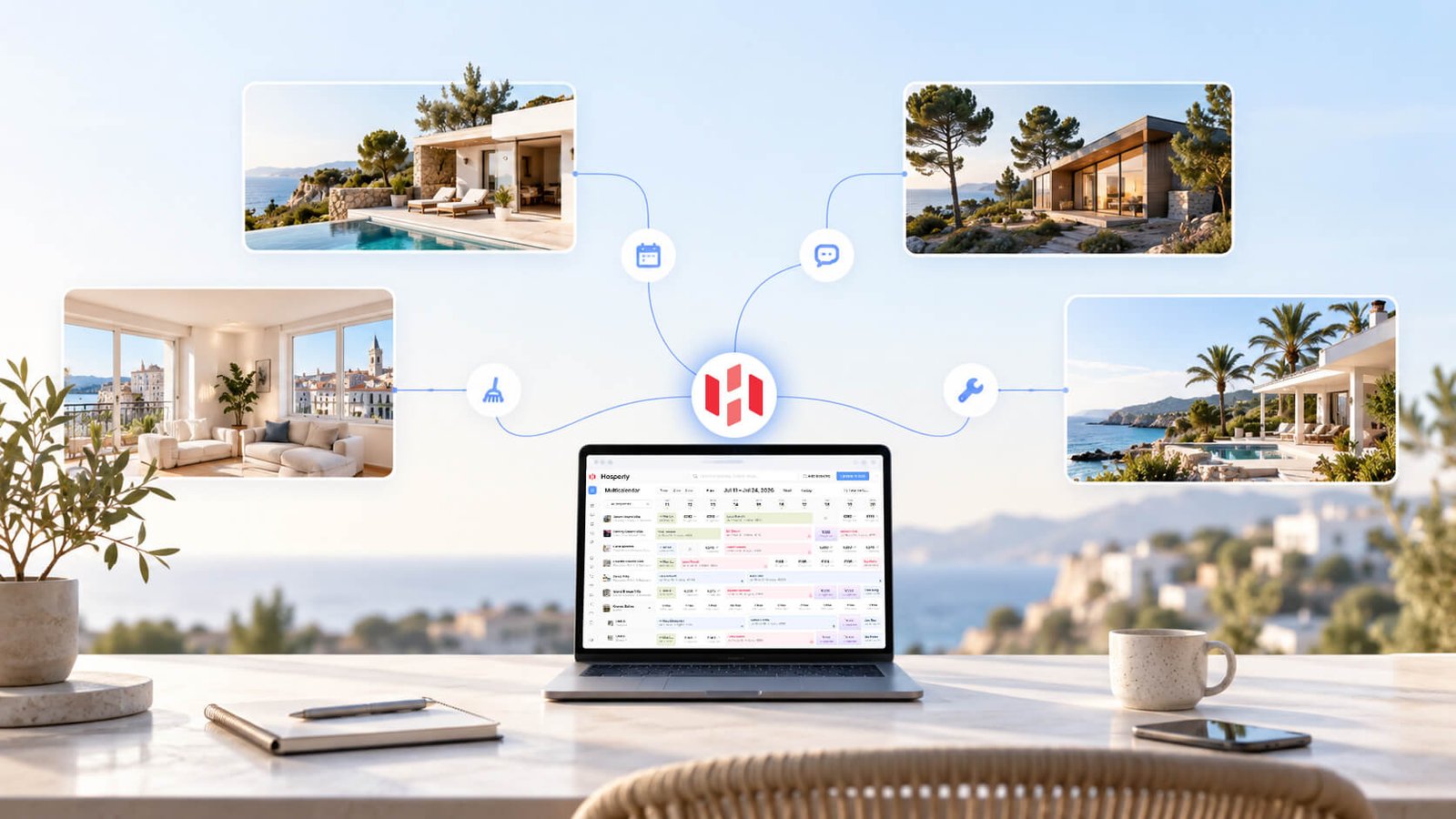
As your portfolio grows, your team needs a clear view of every stay: what’s booked, what needs to happen, and who’s responsible. Connecting bookings, daily operations, guest communication, and guest experience helps your team spot issues early and keep each stay running smoothly.
Hosperly is an AI-powered vacation rental platform built around every stay. It brings these workflows into one connected system, helping your team spend less time coordinating and more time moving your business forward.